
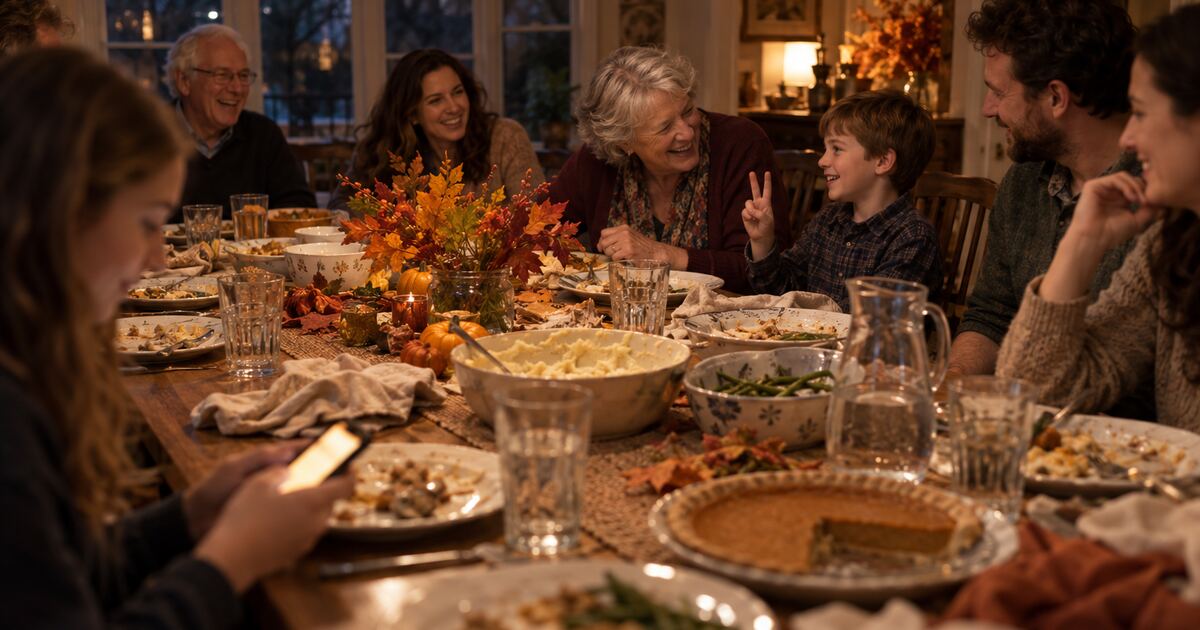
These 40 Thanksgiving would you rather questions are written for a mixed-age table, so a grandparent and an eight-year-old can answer every one of them. They are grouped by the arc of the day: waiting in the kitchen, the meal itself, dessert, and the slow hour on the sofa afterward. None need any setup.
Thanksgiving in the United States falls on the fourth Thursday of November, and the day has a shape most families will recognize: a long wait while the food gets finished, a big meal with turkey at the center, dessert, then everyone slowing down. Each stage suits a different kind of question, so they are grouped that way. As with the Halloween set, each prompt is written as the bare pair; say “would you rather” out loud before it.
Why do Thanksgiving questions need to work for every age?
Because the table has every age at it. Most would you rather lists are written for one audience, a classroom of kids or a group of adults, and at a family table that means half the room either cannot answer or does not want to.
The questions below follow three rules. No prompt needs knowledge a child does not have. No prompt is so silly that an adult feels talked down to. And no prompt touches anything that could start the kind of argument families have at holidays: nothing about money, politics, jobs, school grades, or who is dating whom. Food, habits, silly powers and small opinions are safe ground for everyone.
Would you rather questions while the food is cooking
The kitchen hour is when people are hungry, a little restless and standing around. Keep these quick.
- Peel every potato or wash every pan?
- Smell the turkey all day or taste it once?
- Clear every plate or wash every glass by hand?
- Cook the whole meal or clean up after it?
- Wear an apron all day or a chef’s hat?
- Nap on the floor or walk in the cold?
- Wait one more hour or eat cold food now?
- Mash potatoes with a fork or stir gravy for an hour?
- Taste-test everything or be surprised at dinner?
- Beep whenever food is ready, or have oven mitts for hands?
Would you rather questions for the meal
Once everyone is sitting down, the food is the easiest thing to talk about. These are all about what is on the table.
- Only eat stuffing or only eat mashed potatoes?
- Cranberry sauce on everything or gravy on everything?
- Turkey every day for a month or never again?
- Eat with chopsticks or with a giant spoon?
- Only get a first plate or only eat cold leftovers?
- Give your thankful speech in rhyme or in song?
- Sit at the kids table or the grown-ups table?
- Say one thing you are thankful for or ten?
- A drumstick the size of your arm or a tiny whole turkey?
- Corn on the cob with no butter or butter with no corn?
Would you rather questions for dessert
Dessert is where the kids get louder and the grown-ups get sleepier. These are the silliest set, which is what that point in the meal needs.
- Only pumpkin pie forever or never pie again?
- Whipped cream on your pie or on your nose?
- A slice of every pie or a whole pie of one?
- Pie for breakfast or pancakes for dessert?
- Bake six pies and eat none, or eat one you dislike?
- Have pie-scented hair or a gravy-scented pillow?
- Share your pie with a toddler or with the dog?
- Dessert first or dessert twice?
- Eat pie with no fork or with no plate?
- A pie that never runs out or a cookie jar that refills?
Would you rather questions for after the meal
Everyone is full and settling into the sofa, and the pace slows down. These questions are a little more thoughtful, and they are the set most likely to get a grandparent telling a story.
- Relive your favorite Thanksgiving or skip ahead to next year’s?
- Host every year or never host again?
- Drive six hours for dinner or host twenty people?
- Know every family recipe or every family story?
- Cook with your grandparent as a kid, or teach your grandkid?
- Fall asleep at the table or wash dishes half asleep?
- Start a new tradition or keep every old one?
- Cook for ten people or cook for one hundred?
- Remember every meal or every conversation?
- Have Thanksgiving in summer or keep it in fall?
The grandparent-or-grandkid question is the one to save for when the oldest person at the table is listening. It usually gets the best answer of the evening.
How do you run these at a big table?
Pick one person to ask, usually whoever is not busy with food, and go around the table in order so the youngest and quietest get a turn rather than being talked over. One question per person per round is plenty. At a table of twelve, a single round takes about ten minutes, which is roughly the gap between the main course and dessert.
Let people give reasons, but not long ones. The best moments at a family table come from someone saying “neither” and then being forced to choose anyway, or a child picking something no adult expected. If the table gets into a real debate about pie, let it run.
For a shyer table, start with the meal set, since everyone is already looking at the food. Save the after-the-meal set for the sofa, when people have loosened up.
Should you film it?
If someone wants a clip, the best moment is dessert, when the whole table is together and awake. Prop the phone at the end of the table, wide enough to see most of the faces, and film one round in a single take.
For a family that is already sitting there and does not want to pass a list around, Ranking Filter deals the prompts at random above whoever is holding the phone and records each answer with a 1 to 10 rating, so you can pass the phone down the table and let each person get a surprise. More table games are in Friendsgiving games.
When these run out, would you rather questions has 48 more that work at any table, and this or that questions is the faster version for a group that would rather pick than explain. If you are also running a gathering at work before the holiday, the work icebreaker questions are written for exactly that room.