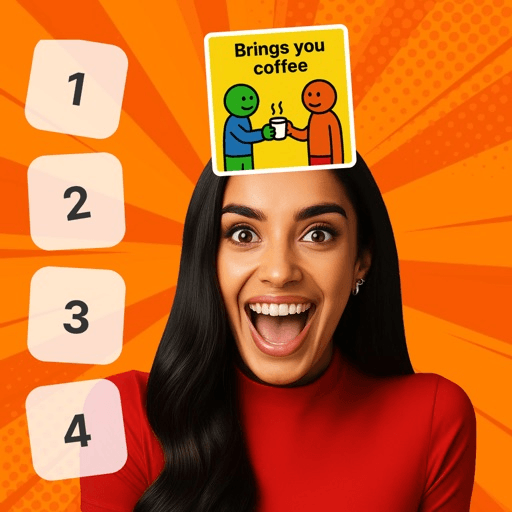
The ranking filter is a short-video format. A random prompt appears above your head while the camera is on you, you react to it, and you tap a number from 1 to 10 to score it. The next prompt loads. Ten or twelve of those, filmed in one take, make a clip.
That is the whole thing, and the simplicity is the point. Nothing about the format is technically clever. What makes it work is that you do not know what is coming, so the face you pull is real, and the number you pick is arguable. Both of those are what people comment on.
How does the loop actually work on camera?
Three beats, repeated. The prompt lands. You react out loud, fast, before you have thought about it. You tap a score on a rail of numbers running down one side of the frame, and the next prompt replaces the last one.
The beat people cut too short is the middle one. A clip where someone reads a prompt and immediately taps a 7 is not content; it is a survey. The reaction between reading and scoring is the entire reason anyone watches, so the useful instinct is to leave the pause in and trim elsewhere.
Prompt sets are usually themed, because a clip that jumps from a food question to a fear question to a relationship question has no through line for a viewer to hold. Texts from guys and texts from girls were the sets that spread first. Love languages, arguments and phobias run close behind, and any short question list works if the prompts are short enough to read in a glance.
Is the ranking filter the same thing as Blind Rank?
They overlap, and the naming confusion is real enough to be worth settling.
TikTok builds a free desktop app called Effect House, which it describes as a way to build effects for TikTok, including games and filters, without writing code. Inside Effect House’s own documentation there is a template called Blind Rank, and the description is close to what most people mean by a ranking filter: it “allows you to assign rank to a variety of food options with a simple tap, choosing from a scale of 1 to 10.” The template ships with food images, and the documentation says the number of items you can rank is adjustable and the image set can be swapped out or added to.
So Blind Rank is a specific, documented template from the platform. “Ranking filter” is what viewers and creators call the family of effects that behave that way, whoever made them. Both names describe the same on-camera loop: a random item, a tap, a score from 1 to 10.
Where they genuinely differ is in what the scoring means. A strict blind ranking asks you to fill fixed ranked slots, one item at a time, without knowing what is still to come, so an early mistake is permanent and the tension builds. The looser ranking filter format gives each prompt its own independent 1 to 10 score with no leaderboard to fill. The first is a game with a losing move. The second is a series of opinions, and it is much easier to film.
What does “filter” mean here?
It is worth naming, because the word does two jobs. In this context a filter is a camera effect that runs while you record, the same category as a face effect or a green screen. It is not a search filter, a sorting control, or anything that narrows a list. If you have searched the phrase and landed on design templates or spreadsheet documentation, that is the collision you hit.
This also explains why the trend is so hard to look up and so easy to find by scrolling. People meet the format on a feed, not in a search box, and the name they attach to it is whatever the caption said.
What makes a prompt good enough to film?
Short, specific, and something a person can have a real opinion about within a second of reading it.
Length is the rule people break most. A prompt sits above your head on a vertical screen, in the second before your reaction, so anything longer than about a dozen words cannot be read in time. “Text back within a minute or wait an hour?” works. A two-line hypothetical with a setup does not.
Specific beats broad. “Do you like breakfast food?” has no answer worth filming. “Ketchup on eggs or never?” has a wrong answer, which is exactly why someone will argue with you about it.
And the prompt has to be one you can score honestly on a 1 to 10 scale. Scores work for situations, habits, choices, fears, foods and opinions. They do not work, and this site will not write them, for rating a person’s appearance. The mechanic invites it and it is not a format worth teaching.
Where do you get the prompts?
You write them, you borrow a friend’s, or you use a list. There are fifteen prompt banks on this site, each built for this format specifically, with prompts kept to that 3 to 12 word range so they read on camera. This or that questions is the easiest set to start with because there is nothing to explain, only a pick. Would you rather questions gives you the stalling face, which is better content but slower. Hot seat questions is the closest match to a rapid-fire scoring clip, and truth or dare questions is the set to bring out when there are three of you and one phone. The full set of lists is worth a scroll before you pick.
Reading a list off a second screen while filming is the part that ruins takes. You break eye contact, the pace dies, and you have already seen the prompt, so the reaction is acting. Ranking Filter draws the prompts at random and records the rail and the note into the clip, so you find out what the prompt says at the same moment the camera does. Solo takes work. Passing the phone around a room works better.
Is the trend over?
It matured. The format spread through late 2025 and search interest in the name has been drifting down since, which our own keyword measurement in September 2026 puts at roughly half its peak. What that number describes is how many people are googling the phrase, not how many people are filming.
Formats like this do not end, they stop being news. The loop is a minute of setup, a real reaction and a number someone can disagree with, and none of that depends on the phrase trending. If you have a group on a sofa and nothing to do, it still works. The longer explainer of the format covers the sets people film most and how they differ.